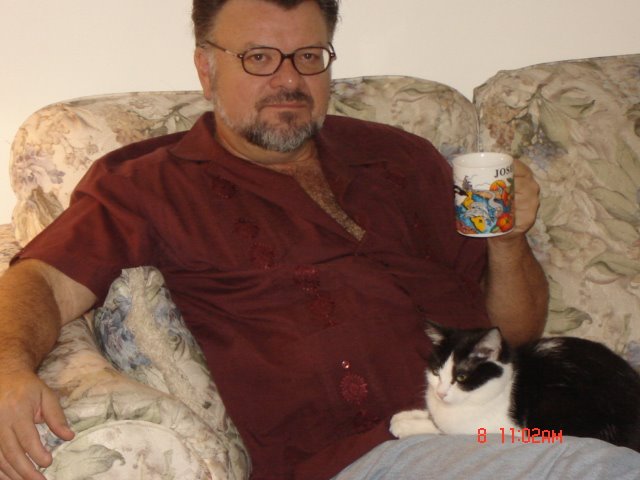
Note: this is taken from a research paper I developed in 2003 for ACTS, and has provided a guiding philosophy of ministry for my work in South Florida over the last 4 years. I have made some significant changes in my views since this was written but I decided to publish it here as I wrote it with some addendums. The major shift is that I would no longer use the phrase "church" planting...I would look for something like "kingdom" planting. I have decided to repost this paper, one section at a time to make it more readable to and to invite discussion.
The great commission given to the followers of Jesus is to go into all the earth, and make disciples of all the nations, baptizing them in the name of the father, son and Holy Spirit, teaching them all that Christ has commanded us. What has Christ commanded us? He has commanded us to love and serve one another, to encourage and care for one another. The activity of making disciples and teaching them to love and serve one another leads to the church, the assembling or gathering together of committed followers of Jesus.
Church planting is the activity of the Holy Spirit through apostolic workers as they persuade men and women to become followers of Jesus and to gather together with other followers of Jesus for mutual service, encouragement and edification.
The Holy Spirit has provided us with a divine example of organic church planting in the relationship between Jesus and his disciples [note: I no longer feel that feel that "church planting" exacty applies to the activity of Jesus with the 12: it was more like forming an apostolic community -- or kingdom network] . We can also find principles of cross-cultural church planting through the example of the Saul of Tarsus and his apostolic team in the later half of the book of Acts. The more closely we follow the biblical pattern given us through Jesus and the twelve, with Paul’s apostolic band, the more likely it is that we will see the same quality of results that we see in the New Testament, as well as the same enduring nature of “fruit which remains” (John 15:16).
Most church planting methods during the last decades of the 20th century were focused on transfer growth rather than new conversion growth. New styles of ministry were developed in order to attract Christian dropouts from dead or dying churches. Sunday morning worship services were updated into the technological age of sound systems, overhead projectors and electric keyboards and then later to multi-media presentations with PowerPoint sermons and gourmet coffee hospitality. Dress became more casual and preaching styles more conversational as churches scrambled to compete to meet the “felt needs” of a dwindling number of Christian consumers.
As we enter into a new millennium, there is a general dissatisfaction with the kind of Christianity produced by contemporary churches in the West. The pastoral failure rate has never been higher. Despite the proliferation (and blessing!) of seeker and purpose-driven mega churches, overall church attendance from January 1997 through June 1998 dropped by 4%. This translates to 8 million Christians who stopped attending Christian services of any kind over an 18 month period.[1] As the Christian Church steadily loses influence not only among secular society, but even among Christians in the U.S. many people are coming to the conviction that the church must change in substance as well as style. The changes that the church will experience in the early decades of the 21st. century will go far beyond methods, style and strategies, to the heart of what defines the church; relationships and structure.
[1] Leonard Sweet, Post-Modern Pilgrims (Broadman and Holman, Nashville, TN: 2000) p. 39
Wednesday, May 30, 2007


Tuesday, May 29, 2007
Lewis: Avoid Clarity
Upon learning that Wormwood's Patient has become a Christian, Screwtape illustrates techniques for confusion:
One of our greatest allies at present is the Church itself. Do not misunderstand me. I do not mean the Church as we see her spread out through all time and space and rooted in eternity, terrible as an army with banners. That, I confess, is a spectacle which makes our boldest tempters uneasy. But fortunately it is quiet invisible to these humans. All your patient sees is the half-finished, sham Gothic erection on the new building estate. When he goes inside, he sees the local grocer with a rather oily expression on his face bustling up to offer him one shiny little book containing a liturgy which neither of them understands, and one shabby little book containing corrupt texts of a number of religious lyrics, mostly bad, and in very small print.
When he gets to his pew and looks around him he sees just that selection of his neighbors whom he has hitherto avoided. You want to lean pretty heavily on those neighbors…Provided that any of those neighbors sing out of tune, or have boots that squeak, or double chins, or odd clothes, the patient will quite easily believe that their religion must therefore be somehow ridiculous. At his present stage, you see, he has an idea of ‘Christians’ in his mind which he supposes to be spiritual but which, in fact, is largely pictoral. His mind is full of togas and sandals and armour and bare legs and the mere fact that the other people in church were modern clothes is a real—though of course an unconscious—difficulty to him. Never let it come to the surface; never let him ask what he expected them to look like. Keep everything hazy in his mind now, and you will have all eternity wherein to amuse yourself by producing in him the peculiar kind of clarity which Hell affords.
--from The Screwtape Letters
One of our greatest allies at present is the Church itself. Do not misunderstand me. I do not mean the Church as we see her spread out through all time and space and rooted in eternity, terrible as an army with banners. That, I confess, is a spectacle which makes our boldest tempters uneasy. But fortunately it is quiet invisible to these humans. All your patient sees is the half-finished, sham Gothic erection on the new building estate. When he goes inside, he sees the local grocer with a rather oily expression on his face bustling up to offer him one shiny little book containing a liturgy which neither of them understands, and one shabby little book containing corrupt texts of a number of religious lyrics, mostly bad, and in very small print.
When he gets to his pew and looks around him he sees just that selection of his neighbors whom he has hitherto avoided. You want to lean pretty heavily on those neighbors…Provided that any of those neighbors sing out of tune, or have boots that squeak, or double chins, or odd clothes, the patient will quite easily believe that their religion must therefore be somehow ridiculous. At his present stage, you see, he has an idea of ‘Christians’ in his mind which he supposes to be spiritual but which, in fact, is largely pictoral. His mind is full of togas and sandals and armour and bare legs and the mere fact that the other people in church were modern clothes is a real—though of course an unconscious—difficulty to him. Never let it come to the surface; never let him ask what he expected them to look like. Keep everything hazy in his mind now, and you will have all eternity wherein to amuse yourself by producing in him the peculiar kind of clarity which Hell affords.
--from The Screwtape Letters
Monday, May 28, 2007
WORSHIP, TECHNOLOGY AND JESUS’ DNA
For the context of the discussion, go to
Covenant Thinklings: The Heart of Worship
William, I liked how you expressed the modern church building mindset in a way that does not cast it as traditional. As Robert has often and correctly pointed out, we don’t want lose our appreciation for ‘tradition’ as in historic heritage…but some ‘modern’ mentalities may need to be altered in order to reach postmoderns. I like the way you describe that as relational communities. That is actually where our movement started out. When I first heard about the shepherding ‘community’ in Lancaster (where Dennis Coll currently serves), it was called Hope Community. As a hippie who had just planted several communes in New England, it lit the fires of my imagination…I remember telling John M. “I didn’t know Christians could do that!”
On the importance of corporate worship. I believe it was Émile Durkheim (http://en.wikipedia.org/wiki/Émile_Durkheim), who in his study of cultures came to the conclusion that every community, human collectivity or tribal group has some form of worship. Even though he was not a believer himself, he believed that it was an essential part of developing a cultural or tribal collective identity (Robert: I love the quote by Peterson of Keillor—Brian got me reading the book).
Robert: on your question about the influence of electronics and other aspects of modern technology on worship. Excellent question! I remember being in a little Mayan Indian church in Guatemala once, with about 12 to 15 people attending. The amplifiers were each bigger than me…when they cranked up the “worship” I could actually feel my internal organs vibrating! That’s when I started rethinking some things.
George Patterson, a Baptist church planter in Central America tells a story that has some application. He found a jungle village of indigenous Hispanics who did not have a church, priest or the scriptures. He arrived in his Jeep with a overhead projector and showed them the “Jesus Film” and led the village elders to Christ. He then taught them that they need to begin to reach the outlying families around the village. When he returned several months (or maybe weeks) later, they had done nothing. When he asked them why, they told him that they could not evangelize because they did not have a jeep or an overhead projector. The next time he visited them, he was riding a mule with a bag of Bibles in Spanish (even the Bibles can be problamatic in such a context when people are often illiterate).
In Mexico, we once visited a little church associated with Sebastian Vazquez that could only be reached by foot, or by horseback. A three hour hike up the mountain. The Pastor’s house was falling down. When we asked how we could pray for them, they gave us a “shopping” list, they need a electronic keyboard, sounds system and an electric guitar. The old acoustic guitar they had was not adequate to bring them into God’s presence. They were not a “real” church without electronics. Don’t laugh….how many us feel we are not a real church without a powerpoint projection system!
This is why I started on a process of ‘descontructing’ the church (not our historic traditions – just some of the 20th century accretions). I posted something in this process on my blog: http://c-far.blogspot.com/2007_05_01_archive.html on May 6th called DECONSTRUCTING THE CHURCH. At some point along the way, I realized that I could not keep up with the pace of electronic technology and seeker oriented strategies for growing a church so I just completely opted out....got rid of most of the technology and went back to 'simple' (2 or 3). I have heard Charles talk about the need to ‘digitize’ the church and to find out what the basic ‘byte’ of church life is (hint: I think he thinks it is the cell – where two or three are gathered).
Some people prefer the term “liquid modernity” over postmodernity. One of the reasons we need to allow new churches to be organic “bytes” (without losing our connection to historic tradition) is to be able reconfigure and flow as needed in this liquid modernity. The church needs to be able “be the church” with an acoustic guitar (or no guitar) on the top of a Mexican mountain, or to use powerpoint and multimedia with 20,000 people in Chicago or LA without one or the other being more correct or more 'church'. The church also needs to show up, and be visibly present in the midst of darkness among the tribal vampire people at Stick & Stein’s in Homestead when my daughter is bar-tending. That is why I try to always take “one or two” with me.
I think that the DNA of the church (don’t get nervous Brian!) and the kingdom and for worship is uber-flexible. Jesus’ corporate DNA can go anywhere, and adapt to and infect any people group, culture, socio-economic lifestyle, technology (or lack thereof) or world view, and like a out-of-control virus begin to transform and uplift them into his eternal kingdom--as long we don’t try to box it up.
Covenant Thinklings: The Heart of Worship
William, I liked how you expressed the modern church building mindset in a way that does not cast it as traditional. As Robert has often and correctly pointed out, we don’t want lose our appreciation for ‘tradition’ as in historic heritage…but some ‘modern’ mentalities may need to be altered in order to reach postmoderns. I like the way you describe that as relational communities. That is actually where our movement started out. When I first heard about the shepherding ‘community’ in Lancaster (where Dennis Coll currently serves), it was called Hope Community. As a hippie who had just planted several communes in New England, it lit the fires of my imagination…I remember telling John M. “I didn’t know Christians could do that!”
On the importance of corporate worship. I believe it was Émile Durkheim (http://en.wikipedia.org/wiki/Émile_Durkheim), who in his study of cultures came to the conclusion that every community, human collectivity or tribal group has some form of worship. Even though he was not a believer himself, he believed that it was an essential part of developing a cultural or tribal collective identity (Robert: I love the quote by Peterson of Keillor—Brian got me reading the book).
Robert: on your question about the influence of electronics and other aspects of modern technology on worship. Excellent question! I remember being in a little Mayan Indian church in Guatemala once, with about 12 to 15 people attending. The amplifiers were each bigger than me…when they cranked up the “worship” I could actually feel my internal organs vibrating! That’s when I started rethinking some things.
George Patterson, a Baptist church planter in Central America tells a story that has some application. He found a jungle village of indigenous Hispanics who did not have a church, priest or the scriptures. He arrived in his Jeep with a overhead projector and showed them the “Jesus Film” and led the village elders to Christ. He then taught them that they need to begin to reach the outlying families around the village. When he returned several months (or maybe weeks) later, they had done nothing. When he asked them why, they told him that they could not evangelize because they did not have a jeep or an overhead projector. The next time he visited them, he was riding a mule with a bag of Bibles in Spanish (even the Bibles can be problamatic in such a context when people are often illiterate).
In Mexico, we once visited a little church associated with Sebastian Vazquez that could only be reached by foot, or by horseback. A three hour hike up the mountain. The Pastor’s house was falling down. When we asked how we could pray for them, they gave us a “shopping” list, they need a electronic keyboard, sounds system and an electric guitar. The old acoustic guitar they had was not adequate to bring them into God’s presence. They were not a “real” church without electronics. Don’t laugh….how many us feel we are not a real church without a powerpoint projection system!
This is why I started on a process of ‘descontructing’ the church (not our historic traditions – just some of the 20th century accretions). I posted something in this process on my blog: http://c-far.blogspot.com/2007_05_01_archive.html on May 6th called DECONSTRUCTING THE CHURCH. At some point along the way, I realized that I could not keep up with the pace of electronic technology and seeker oriented strategies for growing a church so I just completely opted out....got rid of most of the technology and went back to 'simple' (2 or 3). I have heard Charles talk about the need to ‘digitize’ the church and to find out what the basic ‘byte’ of church life is (hint: I think he thinks it is the cell – where two or three are gathered).
Some people prefer the term “liquid modernity” over postmodernity. One of the reasons we need to allow new churches to be organic “bytes” (without losing our connection to historic tradition) is to be able reconfigure and flow as needed in this liquid modernity. The church needs to be able “be the church” with an acoustic guitar (or no guitar) on the top of a Mexican mountain, or to use powerpoint and multimedia with 20,000 people in Chicago or LA without one or the other being more correct or more 'church'. The church also needs to show up, and be visibly present in the midst of darkness among the tribal vampire people at Stick & Stein’s in Homestead when my daughter is bar-tending. That is why I try to always take “one or two” with me.
I think that the DNA of the church (don’t get nervous Brian!) and the kingdom and for worship is uber-flexible. Jesus’ corporate DNA can go anywhere, and adapt to and infect any people group, culture, socio-economic lifestyle, technology (or lack thereof) or world view, and like a out-of-control virus begin to transform and uplift them into his eternal kingdom--as long we don’t try to box it up.
Sunday, May 27, 2007
C.S. Lewis on the Church and Culture
"People say, ‘The Church ought to give us a lead.’
That is true if they mean it the right way, but false if they mean it in the wrong way. By the Church they ought to mean the whole body of practicing Christians. And when they say that the Church should give us a lead, they ought to mean the some Christians--those who happen to have the right talents--should be economists and statesmen, and that all economists and statesmen should be Christians, and that their whole efforts in politics and economics should be directed to putting ‘Do as you would be done by’ into action. If that happened, and if we others were really ready to take it, then we should find the Christian solution for our own social problems pretty quickly.
But, of course, when they ask for a lead from the Church most people mean they want the clergy to put out a political program. That is silly. The clergy are those particular people within the whole Church who have been specially trained and set aside to look after what concerns us as creatures who are going to live for ever: and we are asking them to do a quite different job for which they have not been trained. The job is really on us, on the laymen. The application of Christian principles, say, to trade unionism or education must come from Christian trade unionists and Christian schoolmasters, just as Christian literature comes from Christian novelists and dramatists--not from the bench of bishops getting together and trying to write plays and novels in their spare time."
--from Mere Christinanity
That is true if they mean it the right way, but false if they mean it in the wrong way. By the Church they ought to mean the whole body of practicing Christians. And when they say that the Church should give us a lead, they ought to mean the some Christians--those who happen to have the right talents--should be economists and statesmen, and that all economists and statesmen should be Christians, and that their whole efforts in politics and economics should be directed to putting ‘Do as you would be done by’ into action. If that happened, and if we others were really ready to take it, then we should find the Christian solution for our own social problems pretty quickly.
But, of course, when they ask for a lead from the Church most people mean they want the clergy to put out a political program. That is silly. The clergy are those particular people within the whole Church who have been specially trained and set aside to look after what concerns us as creatures who are going to live for ever: and we are asking them to do a quite different job for which they have not been trained. The job is really on us, on the laymen. The application of Christian principles, say, to trade unionism or education must come from Christian trade unionists and Christian schoolmasters, just as Christian literature comes from Christian novelists and dramatists--not from the bench of bishops getting together and trying to write plays and novels in their spare time."
--from Mere Christinanity
Saturday, May 26, 2007
"The evangelical movement is evolving" NY TIMES
This from the New York Times:
"The evangelical movement, however, is clearly evolving. Members of the baby boomer generation are taking over the reins, said D. G. Hart, a historian of religion. The boomers, he said, are markedly different in style and temperament from their predecessors and much more animated by social justice and humanitarianism. Most of them are pastors, as opposed to the heads of advocacy groups, making them more reluctant to plunge into politics to avoid alienating diverse congregations....
Mr. Warren, along with Mr. Hybels, 55, and several dozen other evangelical leaders, signed a call to action last year on climate change. The initiative brought together more mainstream conservative Christian leaders with prominent liberal evangelicals, such as the Rev. Jim Wallis of Sojourners and the Rev. Ronald J. Sider of Evangelicals for Social Action, who have long championed progressive causes. Notably absent from the list of signatories were several old lions of the Christian right, some of whom were openly critical of the effort: Mr. Falwell; Mr. Robertson, 77; and Mr. Dobson, 71, founder of Focus on the Family."
"The evangelical movement, however, is clearly evolving. Members of the baby boomer generation are taking over the reins, said D. G. Hart, a historian of religion. The boomers, he said, are markedly different in style and temperament from their predecessors and much more animated by social justice and humanitarianism. Most of them are pastors, as opposed to the heads of advocacy groups, making them more reluctant to plunge into politics to avoid alienating diverse congregations....
Mr. Warren, along with Mr. Hybels, 55, and several dozen other evangelical leaders, signed a call to action last year on climate change. The initiative brought together more mainstream conservative Christian leaders with prominent liberal evangelicals, such as the Rev. Jim Wallis of Sojourners and the Rev. Ronald J. Sider of Evangelicals for Social Action, who have long championed progressive causes. Notably absent from the list of signatories were several old lions of the Christian right, some of whom were openly critical of the effort: Mr. Falwell; Mr. Robertson, 77; and Mr. Dobson, 71, founder of Focus on the Family."
Thursday, May 24, 2007
Einstein interview on NPR radio
I heard a great interview today on NPR radio with Walter Isaacson, the author of a new biography on the life of Einstein.
You can access the audio file at http://wamu.org/programs/dr/
The author discusses how Einstein used his creative imagination to General Theory of Relativity. I have ordered the book from Amazon.com.
Einstein was humble but was confident in the “spirit” guiding the material universe. He did not believe that science and faith conflicted. He said science without religion is lame, but religion without science is blind. He was also a rebel and nonconformist.
Einstein believed in an absolute underlying reality, for this reason he was uncomfortable moral relativism. It was an interesting interview... the audio is available at the link above.
Here are some of my favorite Albert Einstein quotes:
"Insanity: doing the same thing over and over again and expecting different results." -Albert Einstein
Only a life lived for others is a life worthwhile." -Albert Einstein
"The most beautiful thing we can experience is the mysterious." -Albert Einstein
"The problems that exist in the world today cannot be solved by the level of thinking that created them." -Albert Einstein
"Science without religion is lame, religion without science is blind." Albert Einstein
You can access the audio file at http://wamu.org/programs/dr/
The author discusses how Einstein used his creative imagination to General Theory of Relativity. I have ordered the book from Amazon.com.
Einstein was humble but was confident in the “spirit” guiding the material universe. He did not believe that science and faith conflicted. He said science without religion is lame, but religion without science is blind. He was also a rebel and nonconformist.
Einstein believed in an absolute underlying reality, for this reason he was uncomfortable moral relativism. It was an interesting interview... the audio is available at the link above.
Here are some of my favorite Albert Einstein quotes:
"Insanity: doing the same thing over and over again and expecting different results." -Albert Einstein
Only a life lived for others is a life worthwhile." -Albert Einstein
"The most beautiful thing we can experience is the mysterious." -Albert Einstein
"The problems that exist in the world today cannot be solved by the level of thinking that created them." -Albert Einstein
"Science without religion is lame, religion without science is blind." Albert Einstein
Wednesday, May 23, 2007
BOOK REVIEW: Surfing The Edge of Chaos
Pascale, Richard T., Mark Millemann, and Linda Gioja. Surfing The Edge of Chaos: The Laws of Nature and the Laws of Business. New York: Random House, Inc., 2000.
Ibidem KW: future; living systems; chaos; business; complexity; church renewal
Several years ago, I was sitting in a hotel room in Colorado Springs with some good friends and colleagues. One of them mentioned a new book called Surfing the Edge of Chaos. I was taking notes on my laptop and there was a wireless hookup in the room. I logged on to Amazon.com, found the book, and ordered 6 copies to be delivered to everyone in the room at their home address. It only took 5 minutes. No trip to Barnes and Nobles, no wondering around to find the book. Welcome to the digital age.
I recently found the book under a pile of ‘books to read’ in my office. Another author I have been reading refers to livings systems and chaos theory and frequently drew from the case studies presented in Surfing. So…last week I finally began to read it (hey, better late than never!).
Surfing the Edge of Chaos presents recent research into Complex Adaptive Systems, a broad based inquiry into the common properties of living things—beehives, ant colonies, networks, enterprises, ecologies and economies. The authors find parallels between living systems or ecological systems and modern business organizations. They focus on conversion from the Newtonian “mechanical” view of the universe to the Einstein ‘relativity’ and quantum paradigm in which complexity, uncertainty and chaos are significant factors. Because of the success of the modern American business model in the twentieth century, business has been slow to adapt to the new scientific paradigms. The authors affirm that nature favors adaptation and fleet-footedness (Pascale, Millemann and Gioja:3), and believe that 21st century markets do the same thing.
Rapid rates of change, an explosion of new insights from the life sciences, and the insufficiency of the machine model have created a critical mass for a revolution in management thinking (Pascale, Millemann and Gioja:5).
The authors use the termite mounds in Africa as a stunning example of a complex adaptive system. The human immune system is a complex adaptive system. This book describes a new management model based on the nature of nature (Pascale, Millemann and Gioja:5).
This book distills four bedrock principles from the living sciences and demonstrates their managerial relevance in a time of disruptive change.
Four Laws of Nature
Equilibrium is a Precursor to Death
When a living system is in a state of equilibrium, it is less responsive to changes occurring around it. This places it at maximum risk. This jibes with a well proven law of cybernetics—Requisite Variety—which states that when a system fails to cultivate (not just tolerate) variety in its internal operations, it will fail to deal with variety that challenges it externally.
The Edge of Chaos is Where Adaptive Change Happens
In the face of threat, or when galvanized by a compelling opportunity, living things move toward the edge of chaos. This condition evokes higher levels of mutation and experimentation, and fresh new solutions are more likely to be found.
Emergence and Spontaneous Self Organization
When the right kind of excitation takes place, independent agents move toward what has been popularized as the “tipping point.” As a result of this disturbance, the components of living systems will self-organize and new adaptive patterns emerge from the turmoil.
Unintended Consequences are an Inescapable Byproduct
Living systems cannot be directed along a linear path. Unforeseen consequences are inevitable. The challenge is to disturb them in a manner that approximates the desired outcome. Traditional enterprises that are faced with discontinuous change are declining. Adapt or die: the choice is that simple and that stark (Pascale, Millemann and Gioja:6).
The authors of Surfing the Edge of Chaos bridge theory and practice through six in-depth case studies of living systems in the business and organizational worlds: British Petroleum, Hewlett-Packard, Monsanto, Royal Dutch/Shell, Sears and the U.S. Army. The authors believe that a “fresh and unorthodox brand of leadership” is necessary in any organization to initiate and “shepherd” an adaptive journey (Pascale, Millemann and Gioja:7-8).
In 1982, Tom Peters wrote In Search of Excellence with an emphasis on the importance of “organizational fit” and top down strategic planning. Peters and Waterman (the co-author) focused on the success of forty-three excellent companies. Within five years after the book’s publication, half of the forty-three companies were in trouble. At present, all but five have fallen from grace. IBM, one of the companies featured, “saw it coming”...but could not change or do anything about the rapidly changing market in computer technology (Pascale, Millemann and Gioja:23).
The authors of Surfing the Edge of Chaos show that a primary reason for business failure is the outmoded “social engineering paradigm” that has more to do with the Newtonian mechanical model than current living systems thinking. Besides IBM, Sears provides a case study in the negative consequences of equilibrium.
Here is their description of the traditional social engineering paradigm (see any applications for the church here?).
Social engineering paradigm:
1) Leaders as Head, Organization as Body. Intelligence is centralized near those at the top of the organization--or those who advise them.
2) The Premise of Predictable Change. Implementation plans are scripted on the assumption of a reasonable degree of predictability and control during the time span of the change effort.
3) An Assumption of Cascading Intention. Once a course of action is determined, initiative flows from the top down. When a program is defined, it is communicated and rolled out through the ranks. Often, this includes a veneer of participation to engender buy-in. That these familiar tenets of social engineering are not compatible with the way living systems works is probably self-evidents.
Social engineering as a context is obsolete--Period (Pascale, Millemann and Gioja:13).
The authors are advocating a change of thinking like mechanics or engineers to gardening. In the church world, I suppose this is reflected in the gradual change of terminology from ‘building’ churches, to ‘planting’ churches which began happening in the 1990s. Natural Church Development by Christian Schwarz in 1996 represented one of the early attempts to apply biological (or as Schwarz called it, ‘biotic’) principles to raising the quality of church life. Recent books like the Organic Church by Neil Cole (2005) and The Forgotten Ways by Alan Hirsch (2006) represents further steps toward the application of livings systems principles to church life. I have to blow my own horn here, and mention that I wrote a 50 page research paper in 2003 called "Organic Church Planting" based on quasi-inductive study of the “Jesus and the twelve” model and exploring some of the ideas that Cole and Hirsch have carried much further since. To bad I didn’t publish it! It has provided the philosophy of ministry that has guided my outreach and gardening efforts in Miami since then.
http://c-far.blogspot.com/2007_04_29_archive.html
The authors of Surfing emphasize a Hebrew model of praxis (even though they don’t realize it): “As a general rule, adults are much more likely to act their way into a new way of thinking than to think their way into a new way of acting.” This accurately describes my last four years of experimenting with house churches, relational networks and redemptive light reflecting in academia. The authors assert that it is “Better to be a beehive than a bureaucracy”
How do we know that the old Newtonian model is giving way to the natural one? Two reasons. The marketplace leaves no choice, and the natural model is closer to the way we as humans really function (Pascale, Millemann and Gioja:14).
Many would say that the American church world is facing an adaptive situation today. Others would probably concur with a stronger word like “the edge of chaos.” How do we adapt? Do we change nothing and just keep doing what we have been doing? It was Albert Einstein who defined insanity as “doing the same thing over and over again and expecting different results."
Some are advocating radical change while others believe that the answer requires a return to the historical legacy of the church, creeds and liturgy. Even in the radical change camp, there are a dozen different kinds of change from structure (house churches), style (pomo), politics and theology (emerging), and DNA and living systems (Hirsch and Cole). There are those who are reacting to the reactors and retreating into a sort of anti-emerging simplistic “I love Jesus” fundamentalism. Sounds like chaos to me!
To conclude this review of Surfing the Edge of Chaos: “living systems isn’t a metaphor. It is the way it is” (Pascale, Millemann and Gioja:15).
Although I have not completely finished the book yet, I highly recommend Surfing the Edge of Chaos for anyone involved in organizational leadership, whether in business or in the church world: after all, it is all the kingdom! I will probably send out a summary of each of the 4 major sections in the book and invite comments on my blog http://c-far.blogspot.com/.
Ibidem KW: future; living systems; chaos; business; complexity; church renewal
Several years ago, I was sitting in a hotel room in Colorado Springs with some good friends and colleagues. One of them mentioned a new book called Surfing the Edge of Chaos. I was taking notes on my laptop and there was a wireless hookup in the room. I logged on to Amazon.com, found the book, and ordered 6 copies to be delivered to everyone in the room at their home address. It only took 5 minutes. No trip to Barnes and Nobles, no wondering around to find the book. Welcome to the digital age.
I recently found the book under a pile of ‘books to read’ in my office. Another author I have been reading refers to livings systems and chaos theory and frequently drew from the case studies presented in Surfing. So…last week I finally began to read it (hey, better late than never!).
Surfing the Edge of Chaos presents recent research into Complex Adaptive Systems, a broad based inquiry into the common properties of living things—beehives, ant colonies, networks, enterprises, ecologies and economies. The authors find parallels between living systems or ecological systems and modern business organizations. They focus on conversion from the Newtonian “mechanical” view of the universe to the Einstein ‘relativity’ and quantum paradigm in which complexity, uncertainty and chaos are significant factors. Because of the success of the modern American business model in the twentieth century, business has been slow to adapt to the new scientific paradigms. The authors affirm that nature favors adaptation and fleet-footedness (Pascale, Millemann and Gioja:3), and believe that 21st century markets do the same thing.
Rapid rates of change, an explosion of new insights from the life sciences, and the insufficiency of the machine model have created a critical mass for a revolution in management thinking (Pascale, Millemann and Gioja:5).
The authors use the termite mounds in Africa as a stunning example of a complex adaptive system. The human immune system is a complex adaptive system. This book describes a new management model based on the nature of nature (Pascale, Millemann and Gioja:5).
This book distills four bedrock principles from the living sciences and demonstrates their managerial relevance in a time of disruptive change.
Four Laws of Nature
Equilibrium is a Precursor to Death
When a living system is in a state of equilibrium, it is less responsive to changes occurring around it. This places it at maximum risk. This jibes with a well proven law of cybernetics—Requisite Variety—which states that when a system fails to cultivate (not just tolerate) variety in its internal operations, it will fail to deal with variety that challenges it externally.
The Edge of Chaos is Where Adaptive Change Happens
In the face of threat, or when galvanized by a compelling opportunity, living things move toward the edge of chaos. This condition evokes higher levels of mutation and experimentation, and fresh new solutions are more likely to be found.
Emergence and Spontaneous Self Organization
When the right kind of excitation takes place, independent agents move toward what has been popularized as the “tipping point.” As a result of this disturbance, the components of living systems will self-organize and new adaptive patterns emerge from the turmoil.
Unintended Consequences are an Inescapable Byproduct
Living systems cannot be directed along a linear path. Unforeseen consequences are inevitable. The challenge is to disturb them in a manner that approximates the desired outcome. Traditional enterprises that are faced with discontinuous change are declining. Adapt or die: the choice is that simple and that stark (Pascale, Millemann and Gioja:6).
The authors of Surfing the Edge of Chaos bridge theory and practice through six in-depth case studies of living systems in the business and organizational worlds: British Petroleum, Hewlett-Packard, Monsanto, Royal Dutch/Shell, Sears and the U.S. Army. The authors believe that a “fresh and unorthodox brand of leadership” is necessary in any organization to initiate and “shepherd” an adaptive journey (Pascale, Millemann and Gioja:7-8).
In 1982, Tom Peters wrote In Search of Excellence with an emphasis on the importance of “organizational fit” and top down strategic planning. Peters and Waterman (the co-author) focused on the success of forty-three excellent companies. Within five years after the book’s publication, half of the forty-three companies were in trouble. At present, all but five have fallen from grace. IBM, one of the companies featured, “saw it coming”...but could not change or do anything about the rapidly changing market in computer technology (Pascale, Millemann and Gioja:23).
The authors of Surfing the Edge of Chaos show that a primary reason for business failure is the outmoded “social engineering paradigm” that has more to do with the Newtonian mechanical model than current living systems thinking. Besides IBM, Sears provides a case study in the negative consequences of equilibrium.
Here is their description of the traditional social engineering paradigm (see any applications for the church here?).
Social engineering paradigm:
1) Leaders as Head, Organization as Body. Intelligence is centralized near those at the top of the organization--or those who advise them.
2) The Premise of Predictable Change. Implementation plans are scripted on the assumption of a reasonable degree of predictability and control during the time span of the change effort.
3) An Assumption of Cascading Intention. Once a course of action is determined, initiative flows from the top down. When a program is defined, it is communicated and rolled out through the ranks. Often, this includes a veneer of participation to engender buy-in. That these familiar tenets of social engineering are not compatible with the way living systems works is probably self-evidents.
Social engineering as a context is obsolete--Period (Pascale, Millemann and Gioja:13).
The authors are advocating a change of thinking like mechanics or engineers to gardening. In the church world, I suppose this is reflected in the gradual change of terminology from ‘building’ churches, to ‘planting’ churches which began happening in the 1990s. Natural Church Development by Christian Schwarz in 1996 represented one of the early attempts to apply biological (or as Schwarz called it, ‘biotic’) principles to raising the quality of church life. Recent books like the Organic Church by Neil Cole (2005) and The Forgotten Ways by Alan Hirsch (2006) represents further steps toward the application of livings systems principles to church life. I have to blow my own horn here, and mention that I wrote a 50 page research paper in 2003 called "Organic Church Planting" based on quasi-inductive study of the “Jesus and the twelve” model and exploring some of the ideas that Cole and Hirsch have carried much further since. To bad I didn’t publish it! It has provided the philosophy of ministry that has guided my outreach and gardening efforts in Miami since then.
http://c-far.blogspot.com/2007_04_29_archive.html
The authors of Surfing emphasize a Hebrew model of praxis (even though they don’t realize it): “As a general rule, adults are much more likely to act their way into a new way of thinking than to think their way into a new way of acting.” This accurately describes my last four years of experimenting with house churches, relational networks and redemptive light reflecting in academia. The authors assert that it is “Better to be a beehive than a bureaucracy”
How do we know that the old Newtonian model is giving way to the natural one? Two reasons. The marketplace leaves no choice, and the natural model is closer to the way we as humans really function (Pascale, Millemann and Gioja:14).
Many would say that the American church world is facing an adaptive situation today. Others would probably concur with a stronger word like “the edge of chaos.” How do we adapt? Do we change nothing and just keep doing what we have been doing? It was Albert Einstein who defined insanity as “doing the same thing over and over again and expecting different results."
Some are advocating radical change while others believe that the answer requires a return to the historical legacy of the church, creeds and liturgy. Even in the radical change camp, there are a dozen different kinds of change from structure (house churches), style (pomo), politics and theology (emerging), and DNA and living systems (Hirsch and Cole). There are those who are reacting to the reactors and retreating into a sort of anti-emerging simplistic “I love Jesus” fundamentalism. Sounds like chaos to me!
To conclude this review of Surfing the Edge of Chaos: “living systems isn’t a metaphor. It is the way it is” (Pascale, Millemann and Gioja:15).
Although I have not completely finished the book yet, I highly recommend Surfing the Edge of Chaos for anyone involved in organizational leadership, whether in business or in the church world: after all, it is all the kingdom! I will probably send out a summary of each of the 4 major sections in the book and invite comments on my blog http://c-far.blogspot.com/.
Monday, May 21, 2007
Cardinal Ratzinger on Religious Dialogue
“If we are ever to attain a planetary consensus on the reasonableness of certain moral principles--such as that to which the Western tradition of natural law and nearly all other cultures once aspired--we will need to interact far more deeply than anyone as yet has done with the Indian tradition of karma, the Chinese tradition of the Rule of Heaven, and the Islamic tradition of the will of Allah.”
--Cardinal Ratzinger in 2004 in a debate with Philosopher Jürgen Habermas.
--Cardinal Ratzinger in 2004 in a debate with Philosopher Jürgen Habermas.
Sunday, May 20, 2007
THE USES AND MISUSES OF KARMA
Hi Mike, that was an intriguing statement. Would you care to expand on that?
Hey John, you are probably right. In learning how to swim in the secular pluralistic sea-change, I fumble a lot. It reminds me of when I was attempting to learn Spanish. After two years of study, and six months of living in Colombia, I got up to make announcements about a picnic in Spanish. What I intended to say, was “I want everyone to BRING extra drinks and food so that we can all have a good time.” I mispronounced the Spanish word for “bring,” (traer) and instead I used “get drunk” (tragar). What everyone heard was “I want you all to GET DRUNK and pig out so that we can have a good time!” oops.
Anytime we set out to learn a new language, worldview or culture, we must be willing to make lots of mistakes. There is no other way to learn to talk in Spanish or French, but to start out blabbing nonsense like a toddler…perfectionists never learn foreign languages, or if they do, they never use them.
I tend to be an extremist and to go overboard when I am ‘on the chase’, especially when it involves crossing cultural barriers. When I was learning Spanish, I read a Spanish bible, I watched Spanish movies, I listened cassette tapes of the Psalms in Spanish as I was going to sleep, I went to Mexican restaurants and eat tacos, I worshiped with Spanish worship music, and even read comic books in Spanish.
Now I feel that God has pointed me toward secular postmoderns. My method for learning to comprehend and speak in secular postmodern is basically the same. So, please bear with me while I learn to talk all over again like a two-year-old.
Having said that, there are a couple of points you raised that I would like to probe. In both of your emails, you used the word “unbiblical.” In my mind, unbiblical and biblical are tricky words, especially if we use them in black and white categories. A large portion of evangelical Christianity believes that speaking in tongues is unbiblical. A couple of centuries ago, slavery was largely considered biblical by the general public, and established churches. I would consider house churches as biblical, but not all my friends would agree with me.
I am not an expert on Eastern religions, so there are probably all kinds of theological implications of karma that I don’t know about, depending on which branch or school of Hinduism defines it (a little like Christianity don’t you think?). However, most of my secular postmodern friends don’t know anything about the actual theology of Hinduism either, they just use “karma” as “what goes around, comes around.” The law of reciprocity. Sowing and reaping.
I’m not sure that it helps to try to explain theological points about the work of Christ to secular postmoderns until there a communicative relationship is established. In fact, as soon as I wrote the previous sentence, I became quite sure that it does not help to explain theological points about Christ or his work in erasing bad karma without establishing a bridge of communication. Besides, right there, at that time and place in the Tampa airport, I had only one shot to establish rapport with that girl. After using the positive energy and karma metaphor, she gave me her email address and wrote a couple of times. She would not have done that if I had tried to go ‘theological’ or ‘Christian’ with her.
Sometimes in our attempts to “get out of the box” we just end up in a bigger box. In our attempts to get of an ‘evangelical’ box or a ‘church’ box, we can end up in the ‘Christian’ or “biblical’ box (here is where I might get myself in trouble). I don’t think we are called to be Christians, or to be ‘biblical’ … we are called to follow Jesus, even when he leads us into the middle of a bunch of new age Hindus or a bunch of radical _______ (like G. H.). I came across a great quote the other day, of all people by Garrison Keiller, of the Prairie Home Companion. He said, “Give up your good Christian life and come and follow Jesus.”
I heard Charles Simpson back in the late 1980s teach on the epochal change we are now in the middle of. He compared it to the dispersion of national Israel and the exile to Babylon. Daniel had to live, study and work with magicians, sorcerers, warlocks, and soothsayers. He had to learn to practice his faith without being adversarial in the pluralistic environment he was in. Some of the Jews were bitter (weeping by the river). They might have accused him of being unbiblical and un-Jewish.
We are in a similar situation today. We are surrounded by new agers, postmoderns, and secular people living in a spiritual void with a confusing hodgepodge of quasi-magical and mystical beliefs drawn from a half dozen world religions. We can try to correct their unbiblical use of spiritual terminology or we can try to understand the meanings behind the terms and use them to establish a relational communication process that may ultimately lead them to Jesus. Or, we can retreat into Christian ghettos and avoid having to learn their language.
I hope that helps clarify my intentions. Thanks for bringing it to my attention.
Hey John, you are probably right. In learning how to swim in the secular pluralistic sea-change, I fumble a lot. It reminds me of when I was attempting to learn Spanish. After two years of study, and six months of living in Colombia, I got up to make announcements about a picnic in Spanish. What I intended to say, was “I want everyone to BRING extra drinks and food so that we can all have a good time.” I mispronounced the Spanish word for “bring,” (traer) and instead I used “get drunk” (tragar). What everyone heard was “I want you all to GET DRUNK and pig out so that we can have a good time!” oops.
Anytime we set out to learn a new language, worldview or culture, we must be willing to make lots of mistakes. There is no other way to learn to talk in Spanish or French, but to start out blabbing nonsense like a toddler…perfectionists never learn foreign languages, or if they do, they never use them.
I tend to be an extremist and to go overboard when I am ‘on the chase’, especially when it involves crossing cultural barriers. When I was learning Spanish, I read a Spanish bible, I watched Spanish movies, I listened cassette tapes of the Psalms in Spanish as I was going to sleep, I went to Mexican restaurants and eat tacos, I worshiped with Spanish worship music, and even read comic books in Spanish.
Now I feel that God has pointed me toward secular postmoderns. My method for learning to comprehend and speak in secular postmodern is basically the same. So, please bear with me while I learn to talk all over again like a two-year-old.
Having said that, there are a couple of points you raised that I would like to probe. In both of your emails, you used the word “unbiblical.” In my mind, unbiblical and biblical are tricky words, especially if we use them in black and white categories. A large portion of evangelical Christianity believes that speaking in tongues is unbiblical. A couple of centuries ago, slavery was largely considered biblical by the general public, and established churches. I would consider house churches as biblical, but not all my friends would agree with me.
I am not an expert on Eastern religions, so there are probably all kinds of theological implications of karma that I don’t know about, depending on which branch or school of Hinduism defines it (a little like Christianity don’t you think?). However, most of my secular postmodern friends don’t know anything about the actual theology of Hinduism either, they just use “karma” as “what goes around, comes around.” The law of reciprocity. Sowing and reaping.
I’m not sure that it helps to try to explain theological points about the work of Christ to secular postmoderns until there a communicative relationship is established. In fact, as soon as I wrote the previous sentence, I became quite sure that it does not help to explain theological points about Christ or his work in erasing bad karma without establishing a bridge of communication. Besides, right there, at that time and place in the Tampa airport, I had only one shot to establish rapport with that girl. After using the positive energy and karma metaphor, she gave me her email address and wrote a couple of times. She would not have done that if I had tried to go ‘theological’ or ‘Christian’ with her.
Sometimes in our attempts to “get out of the box” we just end up in a bigger box. In our attempts to get of an ‘evangelical’ box or a ‘church’ box, we can end up in the ‘Christian’ or “biblical’ box (here is where I might get myself in trouble). I don’t think we are called to be Christians, or to be ‘biblical’ … we are called to follow Jesus, even when he leads us into the middle of a bunch of new age Hindus or a bunch of radical _______ (like G. H.). I came across a great quote the other day, of all people by Garrison Keiller, of the Prairie Home Companion. He said, “Give up your good Christian life and come and follow Jesus.”
I heard Charles Simpson back in the late 1980s teach on the epochal change we are now in the middle of. He compared it to the dispersion of national Israel and the exile to Babylon. Daniel had to live, study and work with magicians, sorcerers, warlocks, and soothsayers. He had to learn to practice his faith without being adversarial in the pluralistic environment he was in. Some of the Jews were bitter (weeping by the river). They might have accused him of being unbiblical and un-Jewish.
We are in a similar situation today. We are surrounded by new agers, postmoderns, and secular people living in a spiritual void with a confusing hodgepodge of quasi-magical and mystical beliefs drawn from a half dozen world religions. We can try to correct their unbiblical use of spiritual terminology or we can try to understand the meanings behind the terms and use them to establish a relational communication process that may ultimately lead them to Jesus. Or, we can retreat into Christian ghettos and avoid having to learn their language.
I hope that helps clarify my intentions. Thanks for bringing it to my attention.
Tuesday, May 15, 2007
THE BORDERS OF THE KINGDOM OF GOD
A major issue in our society since 9/11 is the border issue. How do we control our borders? What does it mean to be a nation if we allow open borders and allow anyone to enter our society who chooses to do so? Do we build a fence and keep out the poor Mexican who wants to work as a brick layer in order to feed his family as well as the Al Queda terrorist?
I have been reading a recent book by Brian McLaren, called The Secret Message Of Jesus. Just to give away a little of the plot, the Secret Message is the kingdom of God and Brian is exploring all the metaphoric quasi-hidden ways that Jesus described the kingdom without actually defining it. The title sounds like a good marketing ploy in the age of Dan Brown, but actually McLaren has a good point…by hinting at the kingdom, and allowing people to glimpse certain aspects of it, he was awakening interest and desire in people to pursue it, to engage it, and to think about it, rather than trying to shove it down their throats with 3 points and an invitation.
In one of this chapters, McLaren deals with how people cross over into the kingdom of God from the domain of darkness, and how we in the kingdom should guard our borders. He effectively shows that there are two possible errors: hostile exclusion and naïve inclusion. Here, McLaren is actually some significant theology about who can be saved and how they are saved. I am a complete novice in this issue but I promise I will read up on it and get back to better set of definitions. There are also some intermediate views.
Basically, the two errors that McLaren focuses on are those who attempt to close the borders and patrol the boundaries of the kingdom in order to keep out any but the most pure, the truly saved (according to the view of the kingdom sheriffs). On the other side are those who want to throw open the borders and let everyone in. This leads to a problem of identity: if everyone comes in, how will the kingdom be any different than the world? McLaren asks, “Can any meaningful kingdom, including the kingdom of God, exist with no boundaries, no outside?” (McLaren:163).
He finally comes down to an intermediate position: the kingdom invites marginal people—“It begins with the least—the sinners, the sick, the poor, the meek, and the children. Entry isn’t on the basis of merit, achievement, or superiority, but rather it requires humility to think again, to become teachable (like a child) and to receive God’s forgiveness and reconciling grace” (165). Nevertheless, the key requirement to cross the border and to become legal immigrant in the kingdom of God is a genuine change of heart. “a requirement that those who wish to enter the kingdom actually have a change of heart—that they don’t sneak in to accomplish their own agenda.”
This is in accordance with the example of Jesus’ tradition of “gathering in an inclusive community” (166). McLaren calls this “purposeful inclusion” and adds that “God seeks to include all who want to participate in and contribute to its purpose, but it cannot include those who oppose its purpose” (167).
McLaren concludes that it is clear that Jesus does not want us “judging, out-grouping, trying to shift between wheat and chaff, or holding people at arms distance” (168). But at the same time his challenge “to repent, to follow him and to learn from his humility and meekness” makes clear that the citizens of the kingdom must want to learn a new way of life and if they don’t pay the full cost, they will remain outside.
Years ago I did a careful inductive study of Jesus’ method of evangelism in the four gospels, for a paper I was writing for Dr. Robinson. It was an eye opener for me as a life-long evangelical. I was unable to find a single example of a mourner’s bench, an altar call, a requirement to assent to a set of theological propositions or the sinner’s prayer. Instead I found a series of encounters between Jesus and lost and hurting people that never twice repeated the same formula but in every case changed their lives (I would imagine that encounter between the rich young ruler and Jesus eventually changed the rich young ruler’s life, even if it made him miserable).
I began to see that salvation was much more of a process or a journey with a series of decisions, rather than normatively a dramatic, one-time life changing even like Saul of Tarsus experienced on the road to Damascus. I saw that there was an element of mystery in the process of regeneration and conversion and that it was above all an entrance into a relationship.
A meaningful passage for me in my attempts to relate redemptively to those around me has been: "He who receives you receives Me, and he who receives Me receives Him who sent Me (Matthew 10:40).
I have noticed that when secular people find out that I am a “spiritual” person, they either retreat or draw nearer in friendship. I am assuming that those who “receive me” are getting a “bug” uploaded to them: love for God and a desire to follow Jesus. IF they receive me (and if he has sent me), they are actually, in real time, receiving him. (Christ in you, the hope of glory).
How do I know when they have legitimately crossed the border into the kingdom? I can’t go on the sinner’s prayer any more….nor even always water baptism. And only God can see the inner change of their heart…so I suppose (and I actually processing this as I write) I must patiently wait to see the fruit in their lives that will indicate the condition of the heart.
In the mean time, it is not my job to stop them at the border or expel them from the kingdom. My job is too continue to be friends, to continue to feed them from the bread of life until they include or exclude themselves from the kingdom by revealing the condition of their hearts.
Any thoughts?
I have been reading a recent book by Brian McLaren, called The Secret Message Of Jesus. Just to give away a little of the plot, the Secret Message is the kingdom of God and Brian is exploring all the metaphoric quasi-hidden ways that Jesus described the kingdom without actually defining it. The title sounds like a good marketing ploy in the age of Dan Brown, but actually McLaren has a good point…by hinting at the kingdom, and allowing people to glimpse certain aspects of it, he was awakening interest and desire in people to pursue it, to engage it, and to think about it, rather than trying to shove it down their throats with 3 points and an invitation.
In one of this chapters, McLaren deals with how people cross over into the kingdom of God from the domain of darkness, and how we in the kingdom should guard our borders. He effectively shows that there are two possible errors: hostile exclusion and naïve inclusion. Here, McLaren is actually some significant theology about who can be saved and how they are saved. I am a complete novice in this issue but I promise I will read up on it and get back to better set of definitions. There are also some intermediate views.
Basically, the two errors that McLaren focuses on are those who attempt to close the borders and patrol the boundaries of the kingdom in order to keep out any but the most pure, the truly saved (according to the view of the kingdom sheriffs). On the other side are those who want to throw open the borders and let everyone in. This leads to a problem of identity: if everyone comes in, how will the kingdom be any different than the world? McLaren asks, “Can any meaningful kingdom, including the kingdom of God, exist with no boundaries, no outside?” (McLaren:163).
He finally comes down to an intermediate position: the kingdom invites marginal people—“It begins with the least—the sinners, the sick, the poor, the meek, and the children. Entry isn’t on the basis of merit, achievement, or superiority, but rather it requires humility to think again, to become teachable (like a child) and to receive God’s forgiveness and reconciling grace” (165). Nevertheless, the key requirement to cross the border and to become legal immigrant in the kingdom of God is a genuine change of heart. “a requirement that those who wish to enter the kingdom actually have a change of heart—that they don’t sneak in to accomplish their own agenda.”
This is in accordance with the example of Jesus’ tradition of “gathering in an inclusive community” (166). McLaren calls this “purposeful inclusion” and adds that “God seeks to include all who want to participate in and contribute to its purpose, but it cannot include those who oppose its purpose” (167).
McLaren concludes that it is clear that Jesus does not want us “judging, out-grouping, trying to shift between wheat and chaff, or holding people at arms distance” (168). But at the same time his challenge “to repent, to follow him and to learn from his humility and meekness” makes clear that the citizens of the kingdom must want to learn a new way of life and if they don’t pay the full cost, they will remain outside.
Years ago I did a careful inductive study of Jesus’ method of evangelism in the four gospels, for a paper I was writing for Dr. Robinson. It was an eye opener for me as a life-long evangelical. I was unable to find a single example of a mourner’s bench, an altar call, a requirement to assent to a set of theological propositions or the sinner’s prayer. Instead I found a series of encounters between Jesus and lost and hurting people that never twice repeated the same formula but in every case changed their lives (I would imagine that encounter between the rich young ruler and Jesus eventually changed the rich young ruler’s life, even if it made him miserable).
I began to see that salvation was much more of a process or a journey with a series of decisions, rather than normatively a dramatic, one-time life changing even like Saul of Tarsus experienced on the road to Damascus. I saw that there was an element of mystery in the process of regeneration and conversion and that it was above all an entrance into a relationship.
A meaningful passage for me in my attempts to relate redemptively to those around me has been: "He who receives you receives Me, and he who receives Me receives Him who sent Me (Matthew 10:40).
I have noticed that when secular people find out that I am a “spiritual” person, they either retreat or draw nearer in friendship. I am assuming that those who “receive me” are getting a “bug” uploaded to them: love for God and a desire to follow Jesus. IF they receive me (and if he has sent me), they are actually, in real time, receiving him. (Christ in you, the hope of glory).
How do I know when they have legitimately crossed the border into the kingdom? I can’t go on the sinner’s prayer any more….nor even always water baptism. And only God can see the inner change of their heart…so I suppose (and I actually processing this as I write) I must patiently wait to see the fruit in their lives that will indicate the condition of the heart.
In the mean time, it is not my job to stop them at the border or expel them from the kingdom. My job is too continue to be friends, to continue to feed them from the bread of life until they include or exclude themselves from the kingdom by revealing the condition of their hearts.
Any thoughts?
Subscribe to:
Posts (Atom)